
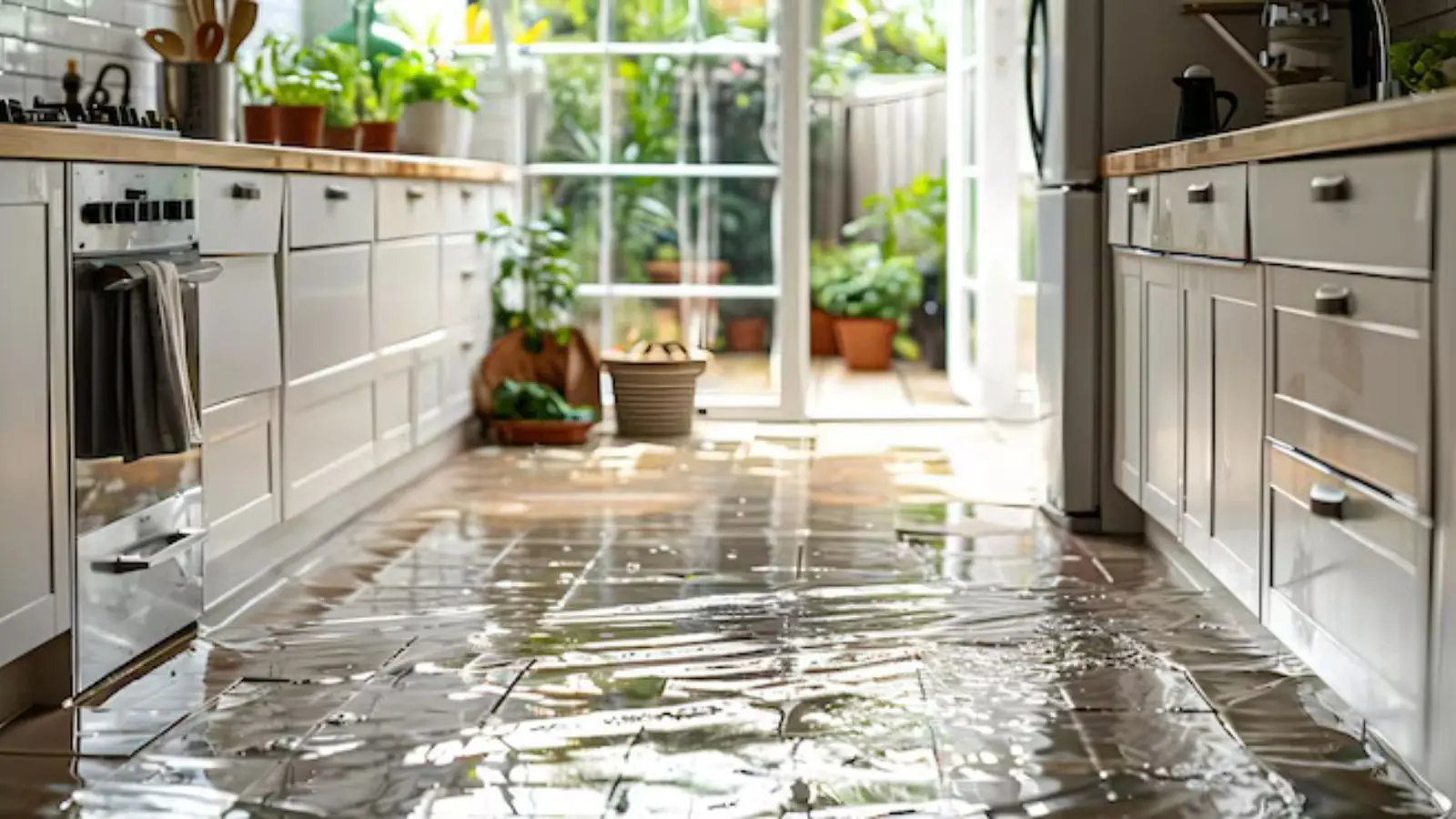
The wet months run October 15 to April 15
LASAN counts October 15 through April 15 as storm season, and the heaviest rain usually comes December through February. At Van Nuys Airport, the closest Valley station with published NOAA normals for 1991 to 2020, February leads with 3.79 inches, January follows with 2.75 and March with 2.50, against a 13.42 inch yearly total.
Most of that arrives in about three months. A roof that sat dry from May to November meets its whole test at once, and the first heavy storm finds every cracked sealant line. From June through September the same station averages just 0.20 inches combined, so a wet ceiling in summer almost never came from the sky.
During storms the city asks residents to limit calls to critical, urgent flooding and to report sewage overflow to 311. Each household can take up to 25 ready-to-fill sandbags from an LAFD neighborhood station, though crews do not fill or deliver them. Phone ahead, and call us for water that has already come inside.
What storms do to 1950s tract homes
In ZIP 91306 the median home was built in 1963, and 5,925 houses, or 39 percent, went up between 1950 and 1959. That is the heaviest single decade in the ZIP. About 62 percent of units are detached houses. Roofs on homes this age have usually been replaced once or twice, and flashing at chimneys, vents and wall joins is the common weak point.
Water gets in at a seam, runs along a rafter and shows up as a stain a room away. Wet attic insulation then holds moisture against the drywall for days. Patching the visible spot misses the path, so crews trace it with a moisture meter and thermal imaging camera, dry the cavity, and only then hand off to water damage repair for the rebuild.
Dry-season leaks that look like nothing
Original supply lines in mid-century houses can corrode from the inside and let go without warning. Braided hoses on washers and toilets fail at the fitting, tank water heaters weep at the base, and a clogged AC condensate line spills into a closet or ceiling. Irrigation breaks soak slab edges and crawl spaces unseen.
LADWP says that if the leak indicator on your meter moves while all water is off, a leak exists somewhere. Swapping a water heater still takes a permit in Los Angeles, even though the Express Permits bulletin spares it a plan check. Ask the city building department how that applies to you.
When water is spreading in Winnetka
Shut the water off at the fixture or the main, then call (818) 337-2642. A dispatcher answers at any hour, asks what the water touched and lines up extraction units, air movers and LGR dehumidifiers to match. Winnetka is roughly 4.6 miles east-northeast of our Vanowen Street base in West Hills.
Around-the-clock dispatch
Storm nights, summer weekends and holidays are all covered, and a crew with an open slot can offer a same-day visit.
Mid-century plumbing
With a 1963 median build year, aging pipes and roofs are the first suspects, not the last.
Mostly owner-occupied
About 57 percent of occupied homes are owned and 31 percent of units sit in buildings of 10 or more, so tell us whether you own or rent.
Scope before work
The crew explains what the job involves and what drives its cost before any equipment is set.
If water is still spreading in Winnetka
Leave out any step that means standing near power or dirty water.
Stop the source
Turn the fixture valve or the main valve to off. For a roof leak, set a bucket and move to the next step.
Check the electricity
Water around outlets or the panel? Stay clear and ring your utility or 911 first.
Protect belongings
Lift rugs, electronics and small furniture, and photograph everything before moving it.
Keep clear of sewage
Backup water is not for wading or mopping. LASAN answers at 1-800-773-2489 around the clock, and (818) 337-2642 handles the cleanup.
Winnetka Avenue, Roscoe and the streets between
Winnetka Recreation Center, at 8401 Winnetka Avenue on the corner of Roscoe Boulevard, is the easiest landmark to give a crew coming from the freeway side. The city survey lists Winnetka Avenue and Roscoe Boulevard among the area's major arteries, so naming the nearest one cuts the confusion when cross streets repeat.
ZIP 91306 is Winnetka's ZIP. The USPS Winnetka Station at 7655 Winnetka Avenue is listed under the post office name Canoga Park, and LAFD Station 104 at 8349 Winnetka Avenue carries the Canoga Park label too. So mail, insurance papers or bills may say Canoga Park. Give dispatch your street address and ZIP rather than the town name, and see our Canoga Park page if you are unsure which area applies.
Which service fits which Winnetka problem
Active water from a split line or overflowing tank needs emergency water removal. A soaked wall or attic after a storm needs water mitigation, where drying equipment runs until readings reach the goal. A closet or ceiling that stayed damp after a condensate overflow may need mold remediation, which follows ANSI/IICRC S520.
Crews also work in nearby Chatsworth. Real numbers come after measurement, so call (818) 337-2642 and describe the damage.
Winnetka water damage questions
Do you cover every ZIP code in Winnetka?
Winnetka is ZIP 91306, which includes Winnetka Avenue, the recreation center at Roscoe Boulevard and the USPS Winnetka Station. Some 91306 mail carries the Canoga Park name, but it is the same ZIP. If your address is 91306, call and we will dispatch from West Hills.
Is emergency water removal available in Winnetka?
Yes. At any hour, including storm nights, a person answers. A same-day visit is offered if a crew has an open slot, and extraction comes before drying. The dispatcher will not promise a clock time but says plainly what is realistic.
Why does my Winnetka ceiling leak only when it rains?
Water is entering at a roof seam, flashing or vent and traveling along framing before it drips. Houses from the 1950s often have aging flashing. Rain falls mostly between October 15 and April 15, so leaks show up then. Have the cavity dried, not just the stain patched.
What dry-season leaks are most common in mid-century houses?
Supply lines, water heaters, AC condensate lines and irrigation breaks. In ZIP 91306 the median home dates to 1963, so original pipes and old tanks are common. Check the pan under the water heater and the closet floor near the AC unit each season.
My mail says Canoga Park. Do you still serve me?
Yes. USPS lists the Winnetka Station under the post office name Canoga Park, and some ZIP 91306 addresses use that name. Tell dispatch your street address and ZIP. We cover Winnetka and Canoga Park from West Hills.
Is storm water through my roof covered by insurance?
Depends on the policy. The state insurance department notes that standard homeowners policies exclude flood, while some policies may cover certain water damage caused by wind-driven rain. Check the exclusions, ask your insurer and photograph the damage before moving anything.
Can I get sandbags before a storm?
LAFD hands out ready-to-fill bags year-round, capped at 25 per household, and will not fill or place them. Ring the station before you drive over. Sandbags help with runoff outside, not a roof leak or burst pipe inside.